


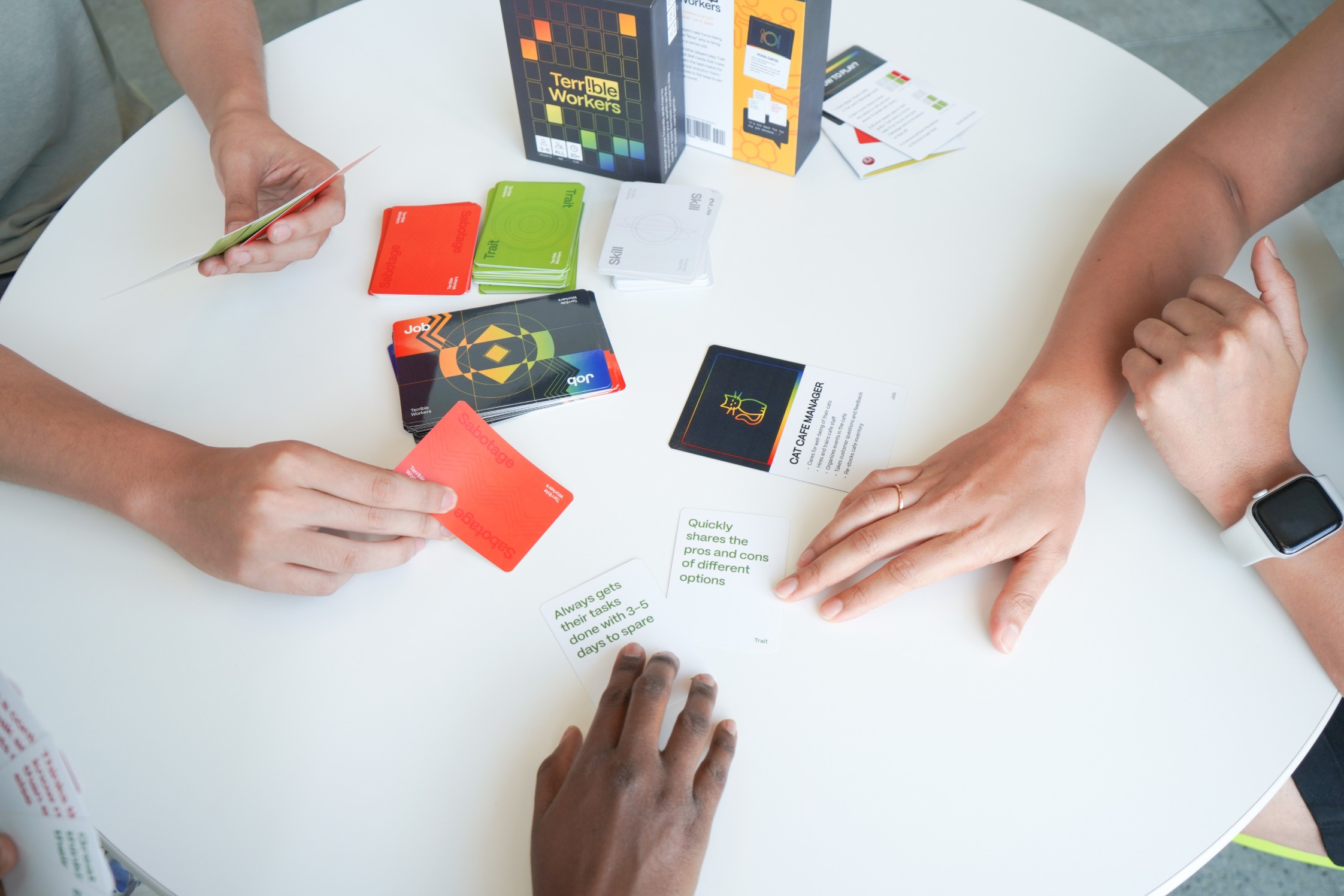

An award-winning card game we built using our 10 educational design heuristics, designed to motivate students to reflect on and develop their people skills through play.
Overview
The Terrible Workers game is designed for classroom-based learning experiences. The game encourages students to be funny, use their sense of humor to be entertaining, persuade other players, be conniving and competitive in a playful context. The game aims to encourage a deeper reflection on what skills are needed in various professional contexts.
Terrible Workers is a card game where players compete to identify who among them would be the worst employee for various jobs, while secretly trying to sabotage others. The game promotes active thinking about interpersonal skills, social dynamics, and workplace competencies, all while keeping the experience fun and engaging.
Game Rules and Demo
Application of Heuristics

Give teens freedom and autonomy
The game is presented as optional and fun, not as a graded educational tool. Students choose how to play, what strategies to adopt, and how to interact with others during gameplay.

Create distance from daily life
By immersing players in a world of quirky job scenarios, the game creates a safe psychological distance. Students learn about workplace dynamics and interpersonal skills through fictional, humorous roles rather than real-life confrontation.

Keep stakes low
There is no grading, no right or wrong answers, and no permanent consequences. The silly premise and short rounds make it easy for students to experiment without fear of failure.

Play first, explain later
Students dive straight into gameplay. The learning objectives around interpersonal skills are discussed afterward during the facilitation and reflection phase, not before.

Make it fun and silly
The game features absurd job titles, humorous sabotage cards, and playful character traits. The lighthearted tone encourages laughter and makes the experience memorable.

Stimulate social connection
The game requires face-to-face interaction, discussion, and negotiation between players. It naturally encourages students from different social groups to engage with each other.

Give sense of anticipation & surprise
Sabotage cards and unexpected role assignments keep players on their toes. Each round brings new surprises, making students eager to play again and discover all possibilities.

Respect teens for their maturity
The game avoids patronizing language or overly childish aesthetics. Its visual design and gameplay mechanics are crafted to feel age-appropriate and engaging for teenagers.

Leverage love for competition
Light competition is woven throughout the game, from trying to identify saboteurs to strategically playing trait cards. The competitive elements drive engagement without creating hostile dynamics.

Promote active thinking during gameplay
Players must strategize, collaborate, and make decisions under pressure. The game promotes critical thinking about interpersonal dynamics and encourages reflection on social behavior.
Learning Outcome
Intended Learning Outcomes
Fundamental traits to be developed in "Terrible Workers", they are more important for students to develop for the intended benefits of the game/educational activity. If not taken away, then the activity/game was not done well enough.
- Awareness that there is no one right answer to everyday social decisions
- Hands-on experience in determining whether specific interpersonal skills are relevant to specific contexts
- Awareness of different types of interpersonal skills
- Demonstrate skill in evaluating which skills are most important to specific jobs
- Build a common reference to work with your interpersonal skills over your technical skills, or at least without a preference
- Exposure to different types of interpersonal skills
Student's Point of View
Below reflects a few unique characteristics or competencies the game's experience can teach, or ideally how the students learn about, ideally through the game's experience.
- Build a critical eye and a unique viewpoint on what really matters in a job
- Awareness of roles and jobs the student is not yet exposed to
- Perspective-taking: considering other peoples' desires and needs
- Leadership: deciding to not blindly follow what others say
- Practice expressing opinions and providing reasoning
- How to self-advocate by giving yourself credit
- Address negative beliefs about a growth mindset
- When things go south, if you have the right people around you, you can put aside it and pick it up and start it over again; and also know when to struggle through for what you want
Classroom Facilitation Guide
As mentioned in the overview, Terrible Workers can be played in any setting with 3-6 players. When it comes to a classroom, a teacher's guidance is important to deliver an effective game experience. Below is a classroom facilitation guide to help teachers effectively run the game.
Prepare cards, form groups
- Prepare a card deck per 3 to 6 player group.
- Shuffle all card types (job, trait, sabotage, dilemma).
- Give clear rules: the rules exist on the game card.
- Let students settle into their tables. Spend time forming groups.
Listen in!
- Be available but not hovering; let them figure it out.
- Avoid individually disrupting the natural and genuine flow of the game.
- Aim to notice body language, social dynamics, and participation gaps.
- Ask the fun stuff: witness the "shoe-taker" or "gossip-dealer" moments; that is the starting point for interesting discussion!
- Listen in; take note of what is said and what is done.
- Listen to students! Listen to what they are thinking as they discuss!
Guide discussion, watch for nuanced changes
- Allow deep, open, honest, and guided (only if needed) debriefing from the game. The teacher can use these prompts after the game.
- Identity competencies.
- Explore the significance of observation as a tool in professional settings.
- Share observations from the reflection as further discussion prompts.
- Ask personal reflection on decisions within or outside game logic.
- Encourage comparing perspectives, focusing on similarities and differences of interpersonal skills in a real estate agent or any single generic job vs all other jobs.